
There is something powerful about nostalgia.
In sport, we constantly look backwards.
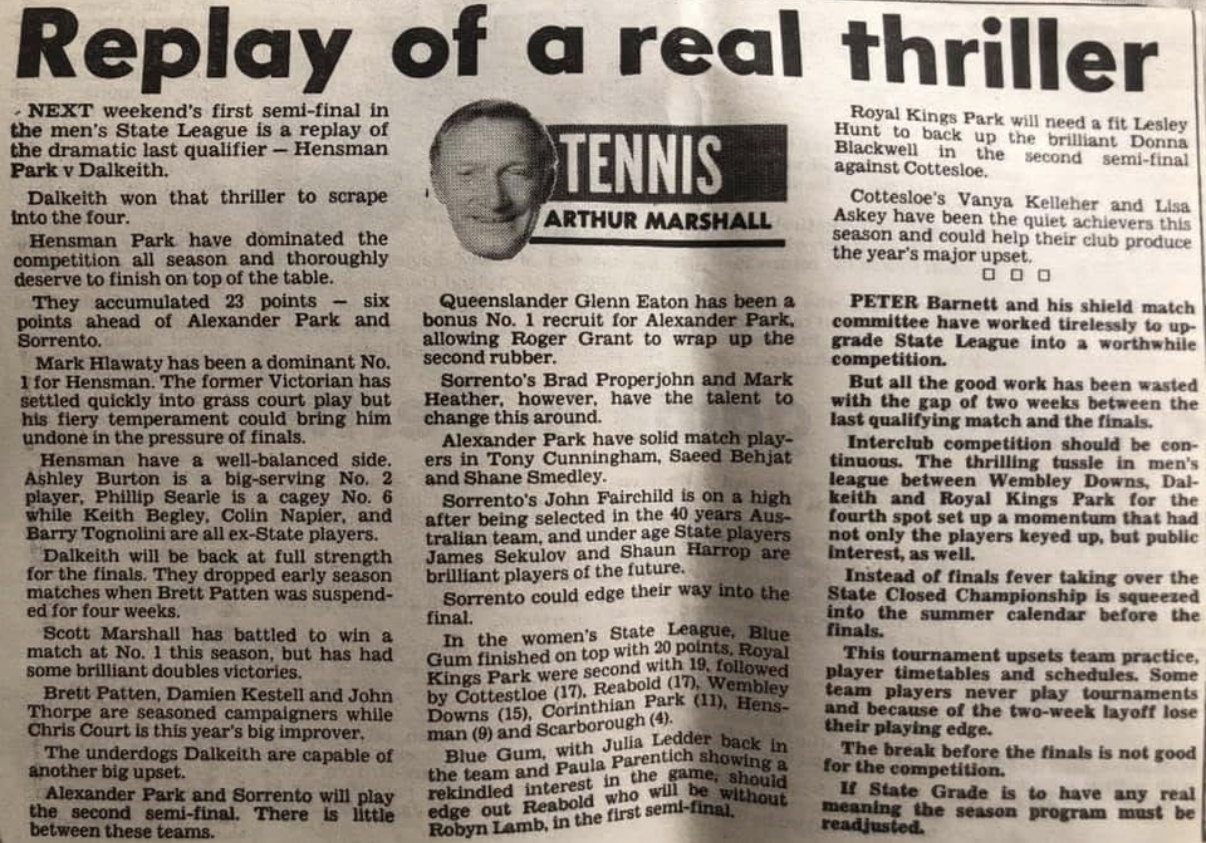
We remember packed clubhouses, strong pennant competitions, great rivalries, tournaments that meant something and Saturday mornings when the sporting pages of the newspaper told you exactly who had won, who had lost and who was emerging as the next big name in Western Australian tennis.
When discussion turns to the current state of WA tennis, one comment continues to come up:
“We need to get back to the way tennis used to be promoted.”
And there is plenty of truth in that.
For those who grew up around WA tennis during the 1970s, 1980s and 1990s, the sport enjoyed tremendous coverage.
Names such as Gary Stocks, Russell Reid, Arthur Marshall and Andrea Mitchell became synonymous with telling the stories of WA sport and WA tennis.
- Tournament results mattered.
- State League mattered.
- Club tennis mattered.
- The leading players became familiar names.
You could open the newspaper and read about a local tournament, a State League battle, a promising junior or one of WA’s leading players.
For many of us, those were wonderful days.
But what if the period of greatest sustained publicity for Western Australian tennis wasn’t actually the 1970s, 80s or 90s?
What if it was much more recent?
The forgotten boom years: 2021–2023
Between 2021 and 2023, WA tennis embarked on an aggressive attempt to put the local game back into the public conversation.
During that period, WA tennis achieved extensive newspaper coverage, with more than 100 newspaper stories and articles promoting players, tournaments, clubs, competitions and the sport generally.
But newspaper coverage was only part of the strategy.
State League was deliberately treated as a product worth promoting.
Approximately 32 State League matches were broadcast through Tennis West’s streaming platform, including a regular Match of the Round with commentary.
Think about that for a moment.
- Local club players were not simply playing a Saturday competition.
- Their matches were being streamed.
- Their names were being discussed.
- Their clubs were being promoted.
- The competition was being presented as something worth watching.
That matters.
Because if the governing body doesn’t believe its premier competition is important enough to promote, why should the wider sporting public?
WA tennis was advertised on mainstream radio
WA tennis was also promoted through 6PR radio advertising throughout the summer.
Importantly, the campaign wasn’t simply promoting the Australian Open.
It promoted Western Australian tennis.
- WA players.
- WA clubs.
- WA competitions.
- WA tennis stories.
There was an understanding that Tennis West’s responsibility was not simply to amplify Tennis Australia’s national campaigns.
Its job was to promote tennis in Western Australia.
There is a significant difference.
State League had depth
At the same time, the State League competition featured eight men’s teams and eight women’s teams.
That created greater club representation, more opportunities for players and more meaningful competition.
State League should be the shopfront of WA club tennis.
It should be where aspiring juniors can watch leading players.
- Where club members support their team.
- Where rivalries develop.
- Where sponsors gain exposure.
- Where clubs build identity.
And where young players begin imagining themselves playing State League one day.
The strength of the competition matters because the health of State League tells us something about the health of the broader competitive tennis ecosystem.
Bringing back tournaments with history
There was also a deliberate effort to reconnect WA tennis with its history.
Traditional tournament names such as Champion of Champions and the State Closed Championships were brought back into the conversation.
- These weren’t simply titles on tournament software.
- They meant something.
- Winning a State Closed Championship should mean something.
- Being Champion of Champions should mean something.
- Sport builds tradition through names, trophies, honour boards, records and stories.
- When we continually rename, restructure or remove competitions, we risk losing the historical connection between generations.
- The player competing today should know who won that same championship 20 years ago.
That is how sporting culture is created.
Give tournaments back to the clubs
Another important philosophy was recognising that Tennis West did not need to run everything itself.
Clubs should have opportunities to host tournaments.
More tournaments mean more competitive opportunities.
More competitive opportunities mean greater participation.
Hosting tournaments can also create revenue for clubs, activate volunteers, bring people through clubhouses and provide additional reasons for members to remain connected with their club.
For decades WA tennis had a thriving tournament calendar.
There were events virtually every weekend.
Players travelled across Perth and regional WA competing.
- Adults played.
- Juniors played.
- Veterans played.
- Open players played.
Different generations mixed at tournaments.
That tournament ecosystem helped create a tennis community.
Once those opportunities disappear, rebuilding them becomes incredibly difficult.
So what happened?
This is the uncomfortable question.
If WA tennis demonstrated between 2021 and 2023 that local tennis could receive substantial newspaper exposure…
If State League could be streamed professionally…
If matches could have commentary…
- If radio advertising could promote WA tennis…
- If traditional tournaments could be revived…
- If clubs could be encouraged to stage events…
- Then why has so much of that momentum disappeared?
- It cannot simply be argued that newspapers no longer cover local sport.
- They did.
- It cannot simply be argued that people won’t watch State League.
- Matches were streamed.
- It cannot simply be argued that WA tennis cannot afford publicity.
- Mainstream promotional campaigns were undertaken.
The evidence is that when somebody makes promoting WA tennis a priority, it can be done.
Leadership priorities matter
The decline of competitive tennis cannot be blamed on one individual or reduced to one simple cause.
Changes in society, competing sports, US college pathways, cost pressures, court access, changing recreational habits and the growth of alternative racquet sports all play a part.
But governing bodies exist to respond to challenges — not simply observe them.
And that is where the current leadership of WA tennis deserves scrutiny.
The Tennis West Board, Chief Executive and marketing leadership should be answering some fundamental questions.
- Where is the strategy to make WA tennis visible?
- Where is the consistent promotion of State League?
- Where is the investment in storytelling around WA players?
- Where is the media strategy?
- Where are the radio campaigns?
- Where is the tournament strategy?
- Where is the rebuilding of meaningful adult competition?
- Where is the connection with the history of the sport?
- Where is the plan to make Western Australian tennis relevant within the broader WA sporting landscape?
These aren’t unreasonable questions.
They are precisely the questions a sporting organisation should expect its members to ask.
You cannot grow what nobody sees
There is an old marketing principle that applies perfectly to sport:
Visibility creates relevance.
- A child cannot aspire to play State League if they don’t know State League exists.
- A sports fan cannot follow WA’s best tennis players if nobody tells their stories.
- A sponsor cannot see value in tennis if competitions receive little exposure.
- A club cannot build excitement around its State League team if the competition itself isn’t being promoted.
And the wider public cannot become interested in WA tennis if WA tennis continually speaks only to people who are already inside the tennis bubble.
- Marketing isn’t an optional extra.
- It is part of participation development.
- It is part of membership development.
- It is part of sponsorship.
- It is part of player development.
And ultimately it is part of building a sporting culture.
Tennis knowledge matters
There is another issue that should not be ignored.
- Sporting administration requires professional skills.
- Governance matters.
- Finance matters.
- Human resources matter.
- Strategy matters.
But so does understanding the sport you are administering.
You need people who understand why club championships matter.
- Why State League matters.
- Why adult tournaments matter.
- Why rankings matter.
- Why traditional events matter.
- Why club volunteers matter.
- Why telling the stories of local champions matters.
And above all, you need leadership with an appetite to put tennis onto the Western Australian sporting map.
Administration without passion eventually becomes administration for administration’s sake.
The decline should concern everyone
WA tennis has faced serious concerns around adult participation, club membership, competitive pathways and the strength and visibility of its premier competitions.
It would be simplistic to suggest publicity alone explains every decline.
But it would be equally foolish to pretend there is no connection between visibility, relevance, participation and opportunity.
- When the sport disappears from newspapers…
- When it disappears from radio…
- When State League becomes less visible…
- When tournaments disappear…
- When competitive opportunities reduce…
- When fewer stories are told about local players…
The sport gradually becomes less visible to the broader community.
And eventually that lack of visibility becomes normal.
It shouldn’t.
Perhaps we don’t need to go back to the 1980s
Maybe that is the great irony.
Whenever people talk about rebuilding WA tennis, they often say:
“We need to get back to the old days.”
Perhaps we don’t need to go back that far.
We should absolutely learn from the magnificent era of the 1970s, 80s and 90s when writers such as Gary Stocks, Russell Reid, Arthur Marshall and Andrea Mitchell helped make WA tennis part of the sporting conversation.
But we should also remember something much more recent.
Between 2021 and 2023, WA tennis showed that the sport could still generate publicity.
It showed State League could be broadcast.
It showed WA tennis could be promoted on mainstream radio.
It showed tournaments with history could be revived.
It showed clubs could be given greater opportunities.
And it showed that WA tennis could compete for attention in a crowded sporting marketplace.
The infrastructure existed.
The audience existed.
The stories existed.
The players existed.
What is required is the will to promote them.
That ultimately brings us to the question Tennis West’s leadership should be required to answer:
If WA tennis could achieve that level of exposure only a few years ago, why can’t it do it now?
Western Australian tennis does not need another strategy document telling people how important growth is.
It needs leadership prepared to make tennis visible again.
Because the greatest threat facing WA tennis may not be another sport.
It may simply be becoming irrelevant to the people who no longer know what they are missing.

15 Responses
Totally agree! Even the ITF last year held in Burswood was barely mentioned in the media and was so poorly attended that it will not be held in WA this year. There needs to be storytelling around players and events in order to inspire players and supporters. Local clubs should absolutely be encouraged to host their own tournaments, for both juniors and adults. The tournament format and scheduling in Belgium allows for very small clubs to host very well-attended and profitable events, attracting top national players. Where have all the AMT tournaments gone? Have to have some options for good players without having to go to college.
Totally agree with everything above. It’s worth looking at how clubs in Europe do this — in Belgium, Holland, Germany and France, clubs (often with just 4 to 6 courts) run their own tournaments over 9 days and they’re extremely well attended and profitable, with 350+ entries across men’s, women’s and juniors. The structure is smart: you enter a division based on your ranking, it’s sudden death with no consolation rounds, and if you win your division you move up to play a higher one the next time. Players often play two tournaments a week. The top division is scheduled at prime time, 7pm, so people can actually come and watch. It’s a genuinely competitive, self-sustaining system, and I’d be surprised if it’s not similar right across Europe.
Finals at those local tournaments draw at least 500 spectators, and yes, the bar is packed too — clubs make a massive profit from that.
Compare that to here. Promotion of tennis in WA is poor. The Perth Future tournament — an actual professional event — was barely in the papers, badly advertised, and badly attended. Dane Sweeny won the Future in Perth and has now reached the second round of the US Open. There was a chance to watch him back then, and barely anyone did.
Perth has beautiful clubs, large clubs. It’s a shame this isn’t happening here.
A lot needs to be done to promote tennis in WA.
I agree with almost all of your paper. The one thing I would add is that some of the problems come from coaching programs where coaches for business reasons seem to keep players totally involved in the internal programs where all the $’s stay in the business and the players seem to have their entire tennis career in their programs and not venturing into external fixture and tournament programs. Also the poor standard of coaching isn’t helping.
The other thing that nobody asks is were are all the new clubs. We have I don’t know how many new suburbs in the last 15-20 years yet I can’t think of a single new club.
From Leach hwy to Rockingham and from the freeway to the ocean I would think no tennis clubs.
You would have umpteen schools in that area yet no clubs for kids to go and play or get coached.
When players shop around for the best deal from clubs it makes it hard to justify to members the cost and time required to have a team in this competition. The governing body does need to find a way to address this.
The players need to also understand their roles here as well. You always see the US College kids promoting their tennis on socials, but rarely do you see them promoting WA State League. I think that comes back to the clubs as well. I feel like there needs to be a pause, then a serious re-think on how this should be done moving forward.
All very true as a junior some 75 years ago it was all ranked junior players aim to play wa state league for your club mine being rkptc
pickleball venues being built, padel venues being built but no new tennis venues in the past 20 years that I can think of… if we look at the geography, effectively, 40% of Perth has no easy access to tennis courts … an absolute disaster in the making 😕
the STC should be pushing people in those areas to Higgins park, hensman park, ribbon park, loton park and so on. As I think it would be a conflict of interest if it became a club.
Michael – they are all wonderful clubs, as are South Perth TC and Maylands too which also fit in the broader catchment. Whilst we see eye to eye on most things, the three points I’d make here are:
1) the STC already competes with all of the catchment area’s clubs given that it runs both coaching programs and tournaments, and actively poaches high performance players for their squads.
2) my view is that the core and fundamental problem with TW is that it is completely removed from the tennis coalface in WA which is non elite & non high performance tennis. From an economic perspective of what keeps the lawns mowed and lights on at tennis clubs – it’s the rank and file members. The basis for investment from local councils is principally membership numbers and membership growth – not pennants shields etc. The TW constitution is explicitly clear that it’s core function is grow tennis in WA, and yet, tennis by both participation and economics are the clubs and everyday members. By making the STC a club, which would then have the same trials and tribulations of all of the other wonderful clubs in WA, TW would be forced to be accountable for club performance. Lots of positives would likely then come out of this as they looked to innovate and solve problems etc eg tools and resources for membership attraction, retention, growth, activisation etc that could then be shared with the clubs – tools that enable the entire pie to grow.
3) Tennis membership across all of the aforementioned clubs should have grown substantially over the past 30 years. Even just for basic context, the population of just the town of City of Vic Park was circa 26k in 1995, it is now roughly 43k, and is envisaged to grow to 64k by 2046. There are more than enough punters to support all of the clubs and where all clubs thrive. The question is what pieces of the puzzle are missing to enable all clubs to run sophisticated BD / sales funnels to drive membership growth. This is where TW should be leading from the front and using their significant marketing budget, to build and support capability in the state’s wonderful volunteer led clubs. TW needs to do much much more to help all WA clubs – by handing them the same bundle of problems and challenges that clubs already face – just maybe they’d start to look to help solve them.
Sorrento has been around since the 1970’s but I think they moved to the new location around 1980/1981. There is also a bunch of clubs splattered through the northern suburbs like ocean ridge ect, however I’m not sure there is any past there just like the southern suburbs no new clubs
Glenn – I had a quick scan and it looks like Ocean Ridge TC is +40 years old, North Shore Country Club is + 40 yo, and Wanneroo TC is + 50 yo. It appears as though the new Alkimos Sporting precinct contains eight multi courts – but it doesn’t appear to actually be a tennis club …
Yes. They would all be approximately the same age. I used to coach up in those areas in the early 80’s, from North Beach through to Wanneroo
the best info that I have been able to find is that South Mandurah TC was founded in 1999. In short, all tennis clubs were built in Perth when the population of Perth then was less than 1.35M. It is now 2.45M. This is truly an abject failure of TW’s administration of the sport given that no new tennis clubs have been built in Perth in nearly 30 odd years, despite the population nearly doubling.
Let’s not lose sight of who is responsible for the demise of state league – not the clubs, not the players… it is Tennis West!
It was only 3 years ago when the men’s and women’s state league had 8 teams competing. Plenty of media coverage (radio adverts, live streaming with commentary, newspaper articles weekly) to excite and delight the sporting community, plus a state league competition that enticed sponsors to come on for tennis west and clubs. The reality is only a few players stayed at one club during the past 29 years. Dave Culley played for 2, Hlawaty played for 2, Big D played for about 4, Leubs played for 3, Patsy played for 4, lutts played for about 4, Flash played for about 4, Props played for about 4… the reality is players did chase the opportunity play up the order. Tennis West have dropped the ball in promoting and providing a platform that excites and delights players, clubs and sponsors…. The blame does sits with tennis west…